
You avoid garage door repair scams by verifying a company’s license and address before booking, getting a written estimate before work starts, and never paying the full amount in cash upfront. Legitimate technicians diagnose the actual problem, explain it in plain language, and don’t pressure you into replacing parts that were working fine. The International Door Association has documented a pattern of scams that target homeowners during emergencies with inflated prices and manufactured urgency, so slowing down before you say yes is often the best protection you have.
Key Takeaways
- Ask for a business name, physical address, and license/insurance details before scheduling anyone.
- Get a written estimate before work begins. Verbal-only quotes are a common scam entry point.
- Scheduling routine garage door maintenance makes it easier to know what your door actually needs, instead of relying solely on a stranger’s diagnosis.
- Treat “your door is dangerous, we need to start right now” as a warning sign, not a reason to skip questions.
- Legitimate technicians rarely require full payment in cash before any work is done.
- If you’re told both springs “must” be replaced without an inspection, ask why.
- Report suspected scams to the International Door Association, the BBB, or your state consumer protection office.
Legitimate Practice vs. Scam Red Flag
Category | What a Legitimate Technician Does | Common Scam Red Flag |
Payment | Accepts card or check, invoices at time of payment | Demands full cash payment before any work starts |
Estimate | Provides a written estimate before work begins | Verbal-only pricing with no documentation |
Diagnosis | Shows you the specific damaged or worn part | Says “everything needs replacing” without evidence |
Urgency | Explains the actual safety risk calmly | Uses fear and pressure to rush a decision |
Company Info | Has a verifiable address, license, marked vehicle | No address, no ID, unmarked vehicle |
Reviews | Spread-out history, mixed and detailed feedback | Reviews bunched in a short window, generic wording |
1. A Technician Demands Full Payment in Cash Before Starting Work
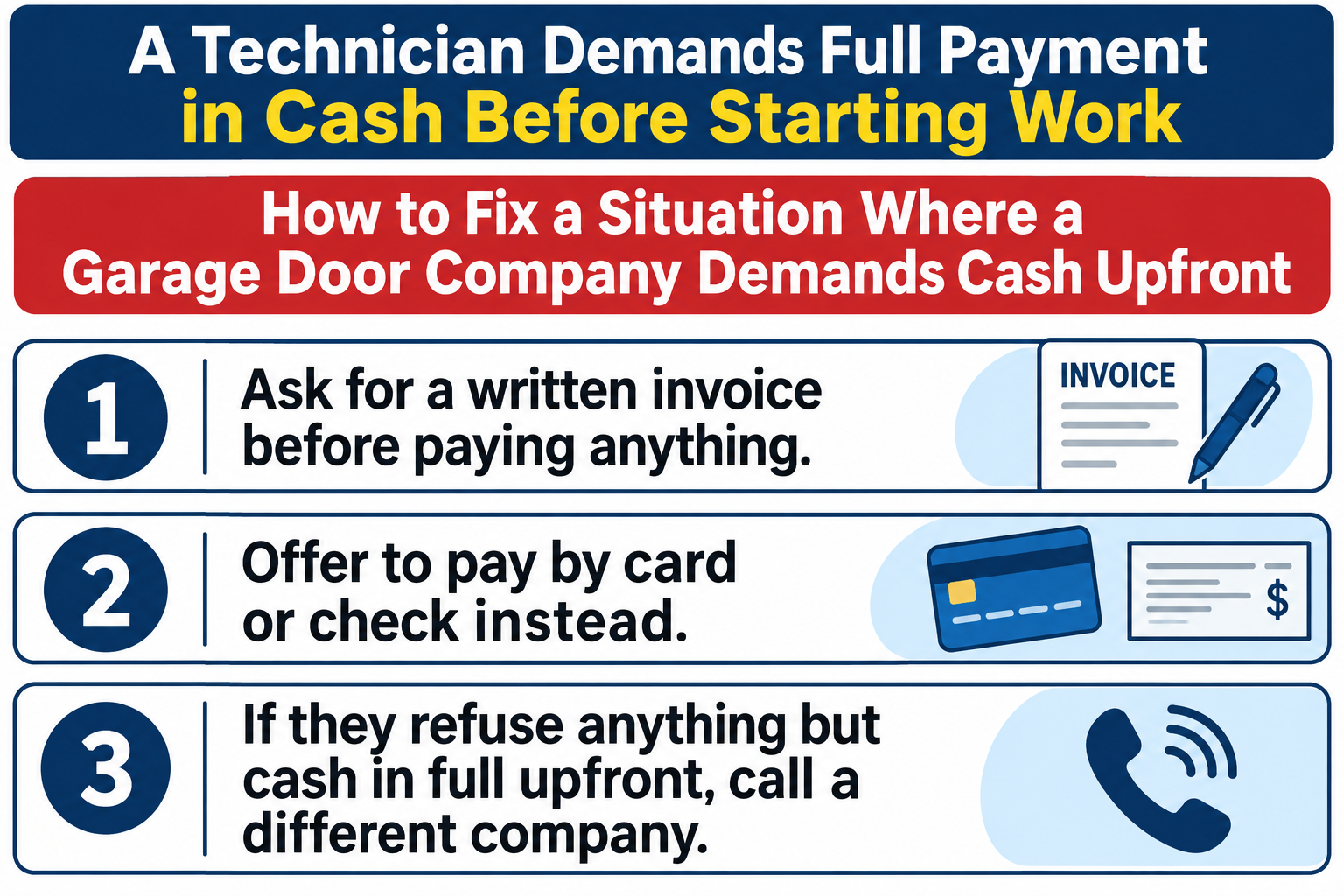
If a technician asks for full cash payment before touching your door, stop and ask why. This is one of the calls we hear most after something’s gone wrong: someone paid upfront and watched the “repair” go sideways with no invoice. Legitimate companies usually accept a card or check and provide a receipt automatically.
How to Fix a Situation Where a Garage Door Company Demands Cash Upfront
- Ask for a written invoice before paying anything.
- Offer to pay by card or check instead.
- If they refuse anything but cash in full upfront, call a different company.
Call a pro if you’re not sure a completed repair was done correctly. A second technician can inspect it honestly.
If you want the full breakdown of how these demands typically play out, read Is It a Red Flag If a Garage Door Company Demands Cash Upfront? 4 Payment Scams Homeowners Should Know.
2. The Price Changes Dramatically Once the Technician Arrives
You get a phone quote, and once the technician arrives, the number doubles. This bait-and-switch is one of the most reported garage door scam patterns nationally. A legitimate technician will show you exactly what changed and why.
How to Fix a Bait-and-Switch Garage Door Repair Quote
- Get the phone quote in writing before the technician arrives.
- If the price jumps, ask them to show you the issue that justifies it.
- Get a second opinion before authorizing anything beyond the original quote.
Call a pro if you want an independent inspection before agreeing to a much higher price.
If a quote has already changed on you, read Why Did My Garage Door Repair Quote Change After the Technician Showed Up? 5 Bait-and-Switch Pricing Tricks to Know.
3. You’re Told Both Springs Must Be Replaced Immediately, No Inspection
Torsion springs often get replaced in pairs since they wear at similar rates. That part is true. The red flag is a technician saying both “must” be replaced within minutes, without ever opening the door or checking for wear. A legitimate spring repair starts with an actual inspection, not a guess.
Why a “Must Replace Both Springs Now” Claim Can Be a Scam Tactic
- A real inspection includes checking both springs for visible wear.
- Ask the technician to show you the issue before agreeing to replacement.
- If only one spring is broken, ask whether replacing both is truly necessary today.
Call a pro if you want a straight answer on whether one spring or two need replacing.
If a technician says both springs need to go today with no inspection, read Do I Really Need Both Garage Door Springs Replaced at Once? 3 Signs a “Repair” Is Actually a Scam.
4. The Company Has No Verifiable Address, License, or Reviews
A legitimate company can tell you where they’re based and point to a review history that predates today. A “company” that’s just a name on a truck with no address is a serious red flag.
How to Verify a Garage Door Company’s Legitimacy Before Booking
- Search the company name plus “reviews” and check for history spanning months, not weeks.
- Ask directly whether they’re licensed and insured.
- Check the business against the International Door Association’s scam awareness resources, which track reported patterns nationwide.
Call a pro if you can’t verify a company yourself. A quick call for a second quote is worth the few minutes it takes.
5. You’re Pressured With “Emergency” Urgency Language on a Non-Emergency Call
Real safety issues exist, but a legitimate technician explains the risk calmly instead of using fear to shut down your questions.
Why Fake Urgency Is a Common Garage Door Scam Tactic
- Ask the technician to explain specifically what could go wrong and why.
- A legitimate answer points to something you can be shown, like a frayed cable.
- An “emergency” that conveniently requires immediate cash is a red flag.
Call a pro if you can’t tell whether a safety issue is real.
6. The Technician Shows Up in an Unmarked Vehicle With No ID
An unmarked van and a technician with no ID tying them to the company you called is a pattern the International Door Association warns about.
How to Fix a Situation Where a Technician Has No Identification
- Ask for ID and confirmation of the company name before letting anyone in.
- Call the company’s main line to confirm the technician was actually dispatched.
Call a pro if you’re uneasy. Reschedule with a company you can verify by phone first.
7. You Can’t Find the Company’s Reviews, or They’re All Suspiciously Recent
A cluster of five-star reviews appearing within one week, written in similar language, is a known manipulation pattern.
How to Spot Fake or Manipulated Garage Door Company Reviews
- Check the dates. A healthy history spreads over months or years.
- Read full reviews, not just ratings. Repetitive phrasing is a warning sign.
- Cross-check the business on more than one platform.
Call a pro if you’d rather ask people you trust locally for a referral instead.
8. The “Repair” Involves Replacing Parts That Were Working Fine
You called about one issue and suddenly need a new opener, rollers, and cables, all at once. In our experience, “everything needs replacing” on nearly every call signals padding, not diagnosis.
How to Tell If You’re Being Sold Unnecessary Garage Door Parts
- Ask the technician to point out what’s wrong with each part.
- Request to see the worn or damaged component, not just be told it’s bad.
- Get additional items quoted separately so you can approve or decline each one.
Call a pro if you want a plain-language breakdown of what’s needed versus optional.
9. There’s No Written Estimate, Invoice, or Warranty Offered
If a company won’t put anything in writing, you have no paper trail if things go wrong. This is often the last domino in a scam: verbal pricing, cash payment, no documentation.
Why a Written Estimate Protects You From Garage Door Repair Scams
- A written estimate protects you from unexplained price changes.
- A final invoice should list parts, labor, and warranty terms.
- If a company resists putting anything on paper, call someone else.
Call a pro if you want a company that documents everything by default.
Protect Yourself, and Know Who to Call
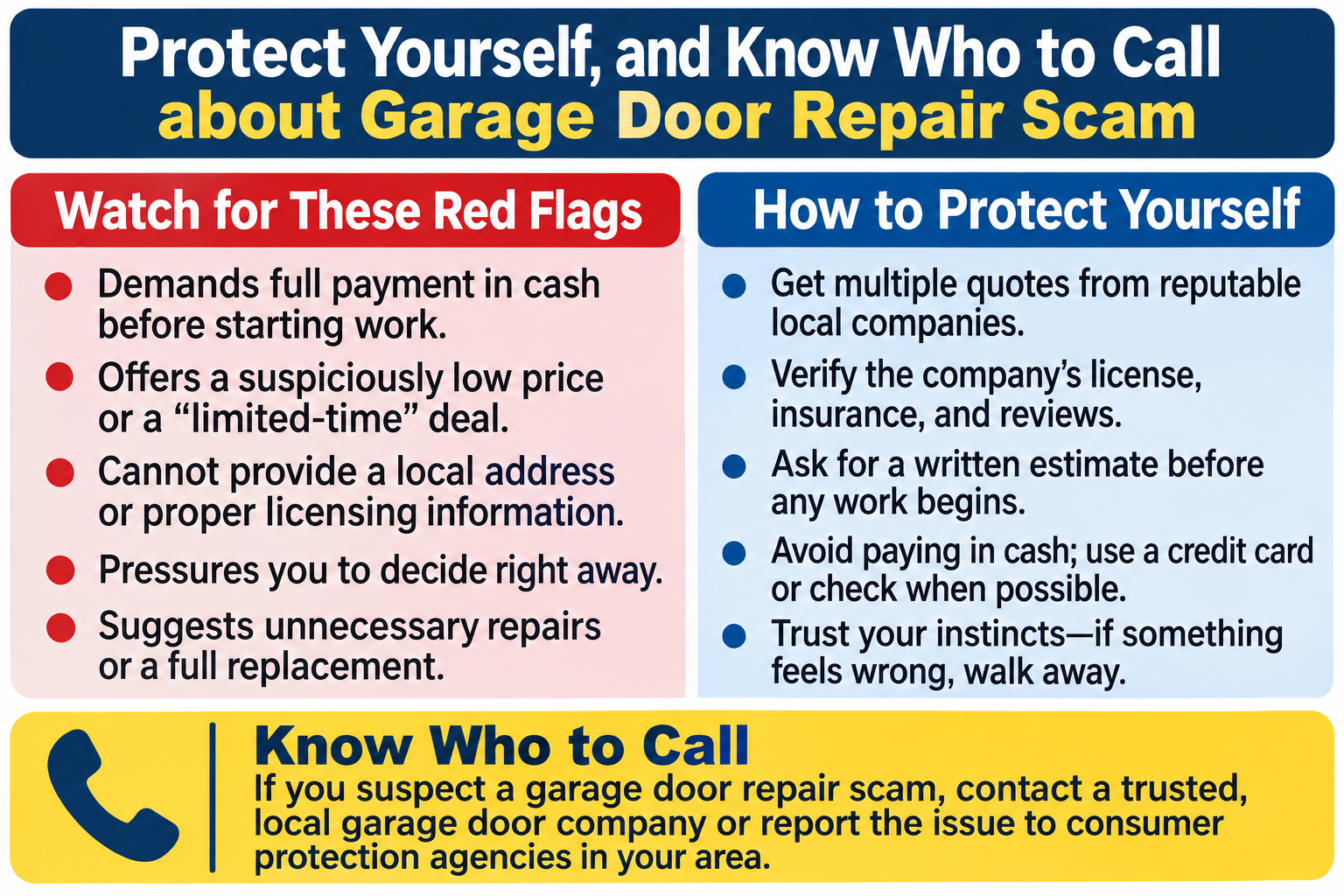
Garage door scams follow recognizable patterns: pressure, cash demands, vague diagnoses, and no paperwork. Dynamic Door Service Tulsa has served Tulsa and the surrounding area for 48 years as a family-owned, licensed business, and we’re glad to answer questions honestly, even if that means telling you the work isn’t needed. Contact us or give us a call to book a service call with our team today.