Yes, it’s a red flag if a garage door company demands full cash payment before any garage door repair has started. Legitimate companies typically accept card or check, invoice at the time of service, and rarely require the entire balance paid in advance. Cash-only, pay-first requests make it nearly impossible to dispute the charge if the work turns out incomplete or unsafe. A small, reasonable scheduling deposit paid by card with a receipt is a very different thing from a full cash payment demanded on your doorstep before a wrench is even picked up.
Key Takeaways
- Legitimate technicians rarely require full payment in cash before any work starts.
- Card or check payment with an invoice is the norm for a real repair company.
- Wire transfers or payment apps sent to a personal account, not a business account, are a major red flag.
- A reasonable scheduling deposit is different from a full cash payment demanded on-site.
- Always get a receipt or invoice, no matter how you pay.
- Report a suspected payment scam to your bank first, then the BBB or the International Door Association.
- Scheduling regular garage door maintenance can reduce how often you need an emergency repair call in the first place.
Legitimate Payment Practice vs. Payment Scam Red Flag
Category | Legitimate Practice | Payment Scam Red Flag |
Payment method | Card, check, or app payment to a verified business account | Cash only, paid in full, before work starts |
Timing | Paid at or after completion, or a small deposit | Full amount demanded before any work begins |
Documentation | Invoice or receipt provided automatically | No receipt, no invoice, no paper trail |
Deposit | Small, reasonable, tied to scheduling | Large deposit with vague justification |
Account | Payment sent to a verified business name | Wire transfer or app payment to a personal name |
1. Full Cash Payment Demanded Before Any Work Begins
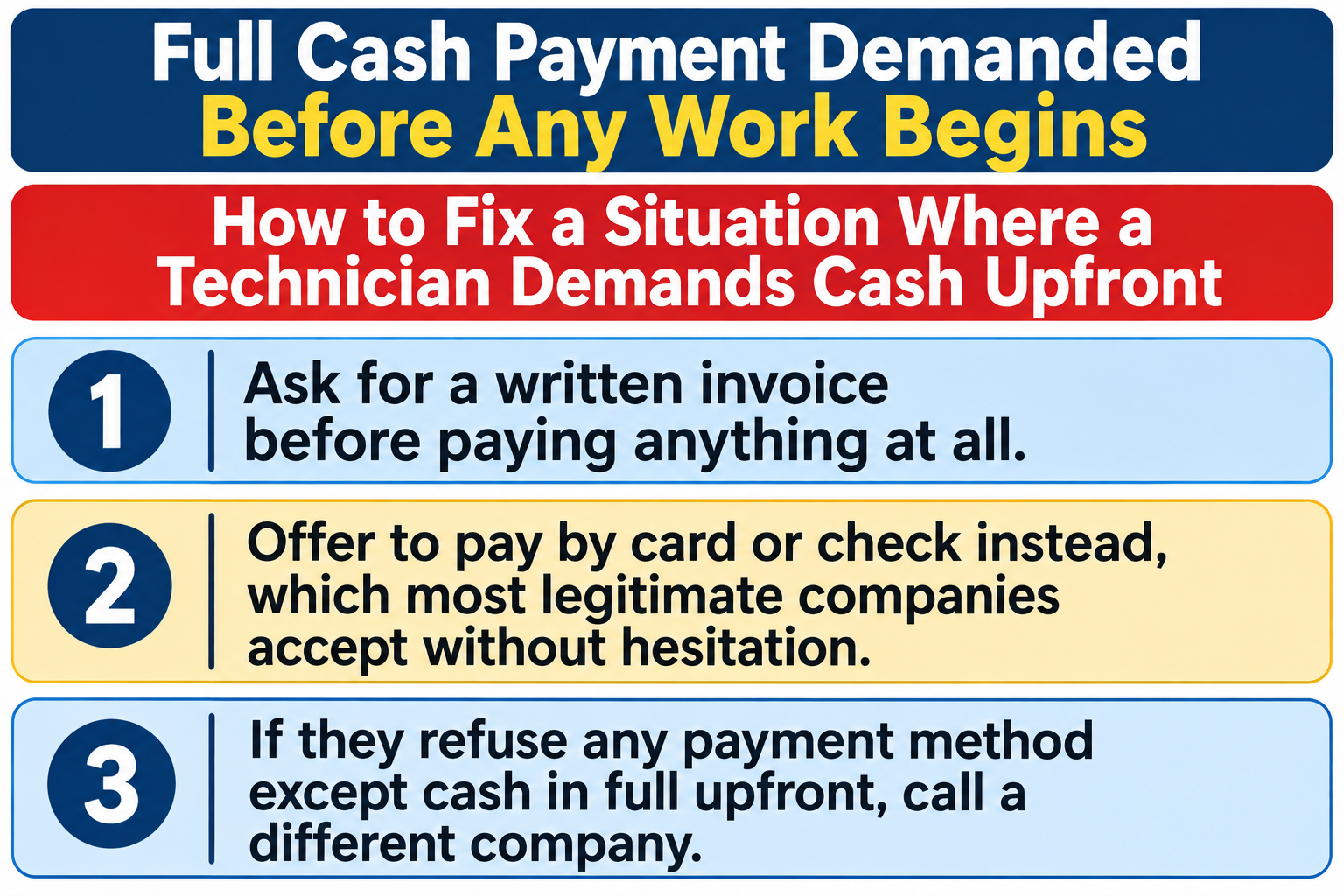
If a technician asks for the entire balance in cash before they’ve even opened your garage, that’s the clearest version of this scam, and it’s designed to remove any leverage you have if the job goes badly. Once cash changes hands with no invoice, you have almost no way to hold anyone accountable if the repair is bad, incomplete, or never happens the way it was described. This is one of the calls we hear most often after the fact: someone paid in full upfront and then had no receipt, no invoice, and no recourse when the door still didn’t work right.
How to Fix a Situation Where a Technician Demands Cash Upfront
- Ask for a written invoice before paying anything at all.
- Offer to pay by card or check instead, which most legitimate companies accept without hesitation.
- If they refuse any payment method except cash in full upfront, call a different company.
Call a pro if you’re not sure whether completed work was actually done correctly. A second technician can inspect it honestly.
If the price also jumped once someone showed up, read Why Did My Garage Door Repair Quote Change After the Technician Showed Up? 5 Bait-and-Switch Pricing Tricks to Know.
2. Wire Transfer or Payment App Requests to a Personal Account
Being asked to wire money, or send a Venmo, Zelle, or Cash App payment, to what’s clearly a personal name rather than a business account is a serious warning sign, even when the person asking seems perfectly friendly and professional on the phone. Personal-account transfers are difficult to reverse and offer none of the fraud protection a card payment does, which is exactly why scammers prefer them over any method that leaves a paper trail or gives you dispute rights.
Why Wire Transfers to a Personal Account Are a Garage Door Payment Scam
- Ask whether the payment is going to a registered business account, and verify the name matches the company.
- Prefer card payments whenever possible, since they carry dispute protections a wire transfer doesn’t.
- Cross-check the company against the International Door Association’s scam awareness resources, which specifically flag payment-related fraud patterns reported across the industry.
Call a pro if you want to verify a company’s legitimacy before sending any payment at all. A quick search or a second quote from an established local business is worth the few minutes it takes.
3. A Deposit Required Before the Company Will Even Schedule a Visit
A modest deposit to hold a scheduling slot isn’t unusual, and plenty of legitimate businesses do this, especially for larger jobs like a full door replacement where materials need to be ordered ahead of time and held specifically for your appointment slot. The red flag is a large deposit with vague justification, demanded before anyone has even looked at your door, with no clear connection to the actual work and no explanation of what happens to that money if you cancel.
Is a Garage Door Deposit Before Scheduling Normal or a Red Flag?
- Ask what the deposit specifically covers and how it applies to the final invoice.
- A reasonable deposit is modest relative to the expected job cost, not the majority of it.
- Get the deposit amount and its purpose in writing before you pay anything.
Call a pro if a requested deposit feels disproportionate to the work described. It’s reasonable to ask for that in writing before committing.
If you want to see all nine warning signs to watch for before you book anyone, read How Do You Avoid Garage Door Repair Scams? 9 Red Flags to Watch For Before You Book.
4. No Receipt or Invoice Given After Payment
If you’ve paid, by any method, and nothing in writing follows, you have no record of what you paid for, what was actually done, or any warranty that might apply down the road. This is often the final step in a scam that started with cash-only payment and vague pricing, and by the time you realize there’s no paperwork, the technician is long gone.
How to Make Sure You Get a Receipt for Garage Door Repair Payment
- Ask for a receipt or invoice immediately after payment, not “later” or “by email eventually.”
- Confirm the invoice lists the specific parts and labor, not just a total.
- If a company won’t provide any documentation after payment, treat that as a serious red flag on its own.
- This applies whether you’re paying for a full door installation or a routine spring repair; the paperwork standard shouldn’t change.
Call a pro if you’re dealing with a company that won’t document a completed job.
If the underlying issue was a spring replacement with no real inspection, read Do I Really Need Both Garage Door Springs Replaced at Once? 3 Signs a “Repair” Is Actually a Scam.
Protect Your Payment, Not Just Your Door
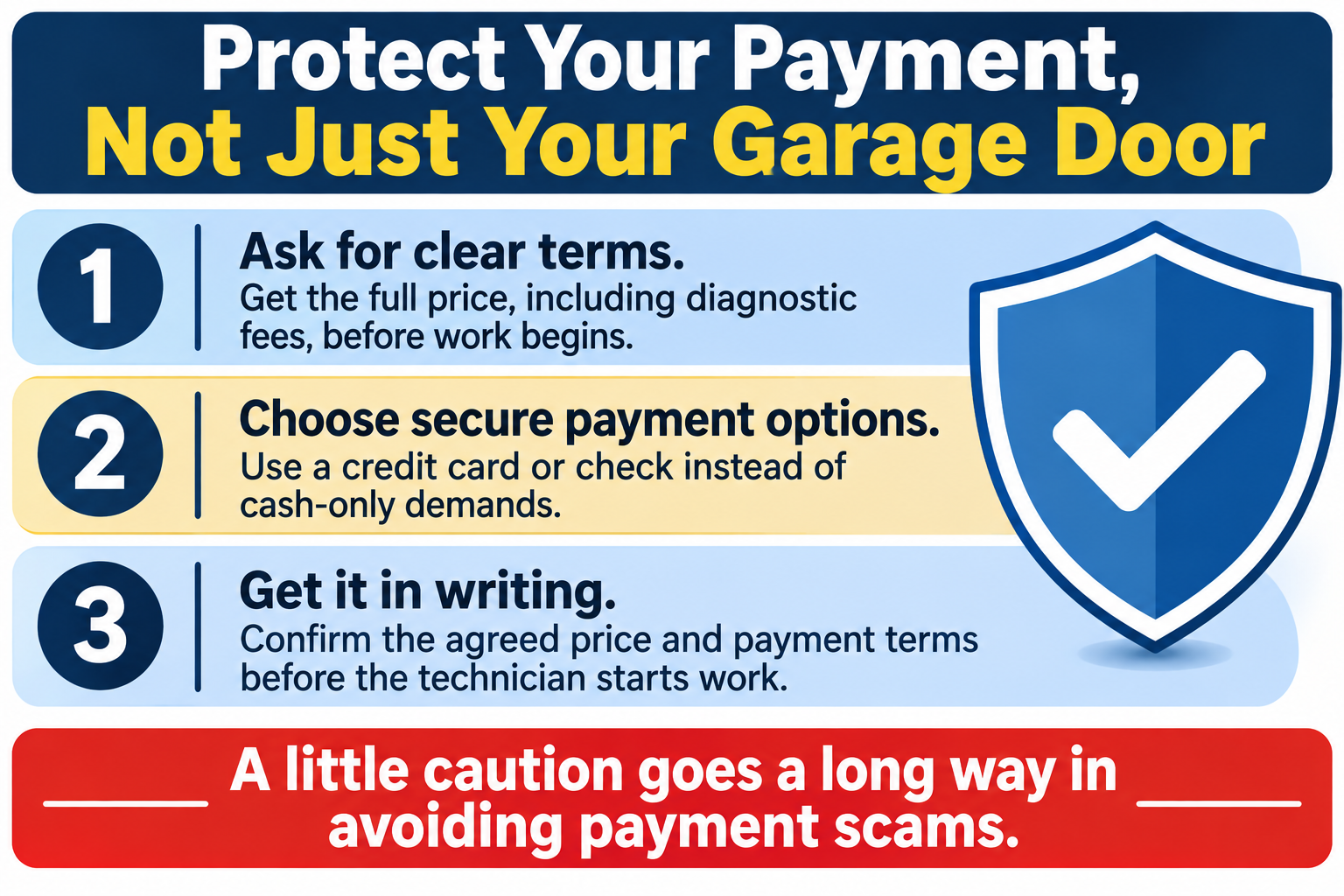
How you’re asked to pay tells you almost as much about a garage door company as the work itself. Cash-only, pay-first, no-receipt requests are a pattern, not a coincidence, and companies that behave this way with payment often cut the same corners on the actual repair. Dynamic Door Service Tulsa accepts standard payment methods and provides documentation as a default, not an afterthought. Contact us or give us a call to book a service call with our team if you want a company that pays attention to this from the start.