
Your garage door repair quote usually changes after the technician arrives because of a bait-and-switch tactic, not a genuine surprise. The phone quote gets you to book, then a “diagnostic fee,” an inflated spring assessment, or a vague line item shows up once you’re standing there feeling pressure to just get it done. Sometimes a price does change for a legitimate reason, but a real technician will show you the specific issue and explain the new number in plain terms. If they can’t, that’s the signal something’s off.
Key Takeaways
- Get your phone quote in writing (text or email) before anyone comes out.
- Ask what changed and ask to see the specific part or issue that justifies it.
- Watch for vague line items like “miscellaneous labor” on the final invoice.
- Confirm any part that’s billed was actually removed and replaced, not just claimed.
- A quote that’s “just an estimate” with no real cap defeats the purpose of quoting at all.
- Get a second opinion before authorizing anything beyond what was originally quoted.
- Scheduling routine garage door maintenance can catch small issues before they turn into a surprise invoice.
Legitimate Price Change vs. Bait-and-Switch Trick
Category | Legitimate Price Change | Bait-and-Switch Trick |
Explanation | Tech shows you the specific new issue | Vague reasoning, or none at all |
Documentation | New cost is itemized and explained | “Miscellaneous” or bundled line items |
Timing | Discovered during actual inspection | Announced almost immediately on arrival |
Parts | You can see the part that was replaced | Charged for parts with no proof of use |
Original quote | Treated as a real number with a cap | Called “just an estimate” with no limit |
1. The “Diagnostic Fee” That Wasn’t Mentioned on the Phone
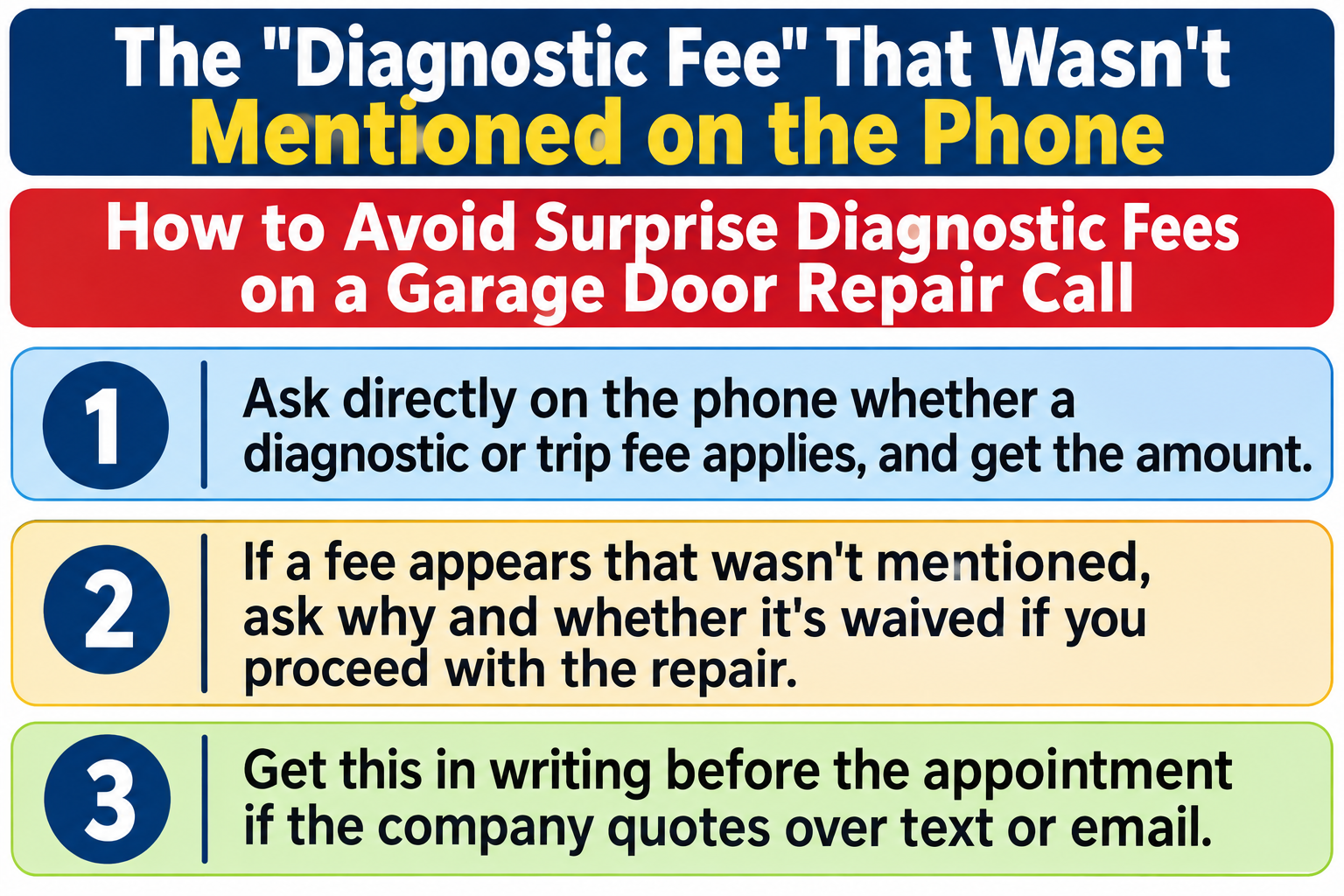
You booked a repair, not an inspection, but the technician tacks on a diagnostic fee the moment they arrive, something never mentioned when you scheduled. Sometimes this fee is legitimate and standard practice, especially for complex opener issues that take real time to diagnose. The problem isn’t that diagnostic fees exist. It’s when they show up as a surprise, used to pad the bill after you’ve already committed to having someone in your driveway.
How to Avoid Surprise Diagnostic Fees on a Garage Door Repair Call
- Ask directly on the phone whether a diagnostic or trip fee applies, and get the amount.
- If a fee appears that wasn’t mentioned, ask why and whether it’s waived if you proceed with the repair.
- Get this in writing before the appointment if the company quotes over text or email.
Call a pro if a company won’t answer a simple fee question over the phone. That reluctance alone tells you something.
If you want to see the complete list of nine red flags to check before booking anyone, read How Do You Avoid Garage Door Repair Scams? 9 Red Flags to Watch For Before You Book.
2. The Quote Balloons Once They Say Your Springs Are “More Damaged Than Expected”
Springs are one of the most common places this trick shows up, since most homeowners can’t easily verify spring condition themselves and the components are under real tension, which makes people understandably cautious about questioning a technician. The technician glances at the springs and declares them “worse than we thought,” and the quote jumps well beyond the original number, often specifically because they know most people won’t push back on a safety-adjacent claim.
Why “More Damaged Than Expected” Is a Common Garage Door Pricing Trick
- Ask the technician to physically show you the damage they’re describing.
- A legitimate spring issue looks like visible rust, gaps in the coils, or a clear break, not just a verbal claim.
- A fair-priced spring repair starts with showing you the damage, not just naming a bigger number.
If you want a deeper look at how spring-related scams specifically play out, read Do I Really Need Both Garage Door Springs Replaced at Once? 3 Signs a “Repair” Is Actually a Scam.
Call a pro if you want someone to physically verify spring condition before authorizing extra cost.
3. You’re Charged for Parts That Were Never Actually Replaced
This one is harder to catch in the moment, since most people don’t inspect their garage door hardware closely and have no real baseline for what a roller, cable, or bracket is supposed to look like before and after service. You’re billed for a new part, but the one on your door still looks worn, old, or original, and by the time you notice, the technician is already gone.
How to Verify the Parts You’re Being Charged for Were Really Used
- Ask to see the old part that was removed before the technician leaves.
- Take a quick photo of the hardware before and after the appointment.
- If something billed doesn’t look new or doesn’t match the invoice description, ask about it before paying.
Call a pro if you suspect a part wasn’t actually replaced. A second, independent inspection can confirm what’s genuinely new versus original.
4. The Final Invoice Includes Vague Line Items Like “Miscellaneous Labor”
A clear invoice lists what was done, the parts used, and the time spent. A vague one bundles cost into categories like “miscellaneous,” “additional labor,” or “service adjustment,” with no way to tell what you’re actually paying for.
Why Vague Invoice Line Items Are a Garage Door Pricing Red Flag
- Ask for an itemized breakdown before you pay, not after.
- Push back on any line item you can’t connect to a specific task or part.
- The International Door Association’s scam awareness resources list unclear billing as one of the recurring patterns reported nationwide, so you’re not alone in running into this.
Call a pro if an invoice doesn’t add up and the company won’t clarify it. Document everything and consider a second opinion.
5. You’re Told the Original Quote Was “Just an Estimate” With No Cap
If a company tells you the number they gave you over the phone was never meant to be binding, and there’s no ceiling on what the final bill could be, the quote wasn’t really a quote. It was a number designed to get you to say yes and get a foot in the door, with the real number arriving only after you’re already committed to having the work done.
How to Get a Garage Door Repair Quote That Actually Holds
- Ask directly: “Is this a firm quote, or could it change, and by how much at most?”
- Get any cap or range in writing before work begins.
- If a company insists every quote is “just a ballpark” with no limit, treat that as a serious red flag on its own.
If that same company also demands cash upfront, read Is It a Red Flag If a Garage Door Company Demands Cash Upfront? 4 Payment Scams Homeowners Should Know.
Call a pro if you want a company that quotes with an actual number and stands behind it in writing.
Don’t Let a Changing Price Rush Your Decision
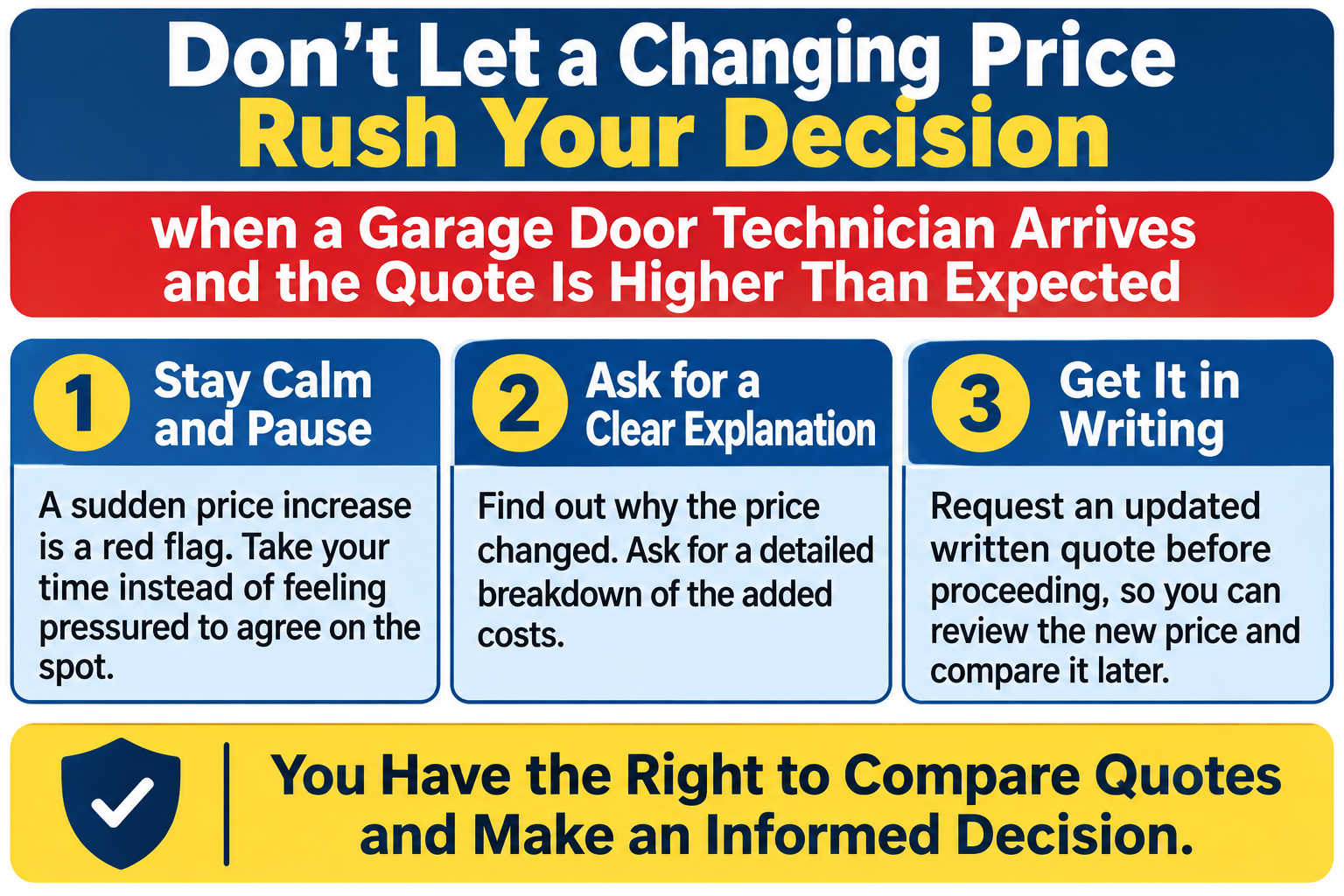
A quote that changes once someone’s in your driveway is one of the most common ways homeowners get overcharged for garage door work, and it’s rarely a coincidence when it happens more than once with the same company. Dynamic Door Service Tulsa quotes and invoices in writing as a default, not an exception. Contact us or give us a call to book a service call with our team directly for a number you can actually count on.
2 Responses